The value of long-term relationships and early contractor involvement
The value of long-term relationships and early contractor involvement
CIOB 2025 Client Award winner.

In May 2025, the Merseyside Fire and Rescue Authority (MFRA) won the CIOB’s 2025 Client Award for their new Aintree Community Fire Station & Training and Development Academy campus in Aintree, Merseyside.
The recognition reflects MFRA’s exemplary approach to capital delivery, strategic partnership, and public value. For construction clients across the UK, the publicly funded project serves as a model for how to commission complex infrastructure with clarity, purpose and long-term impact.
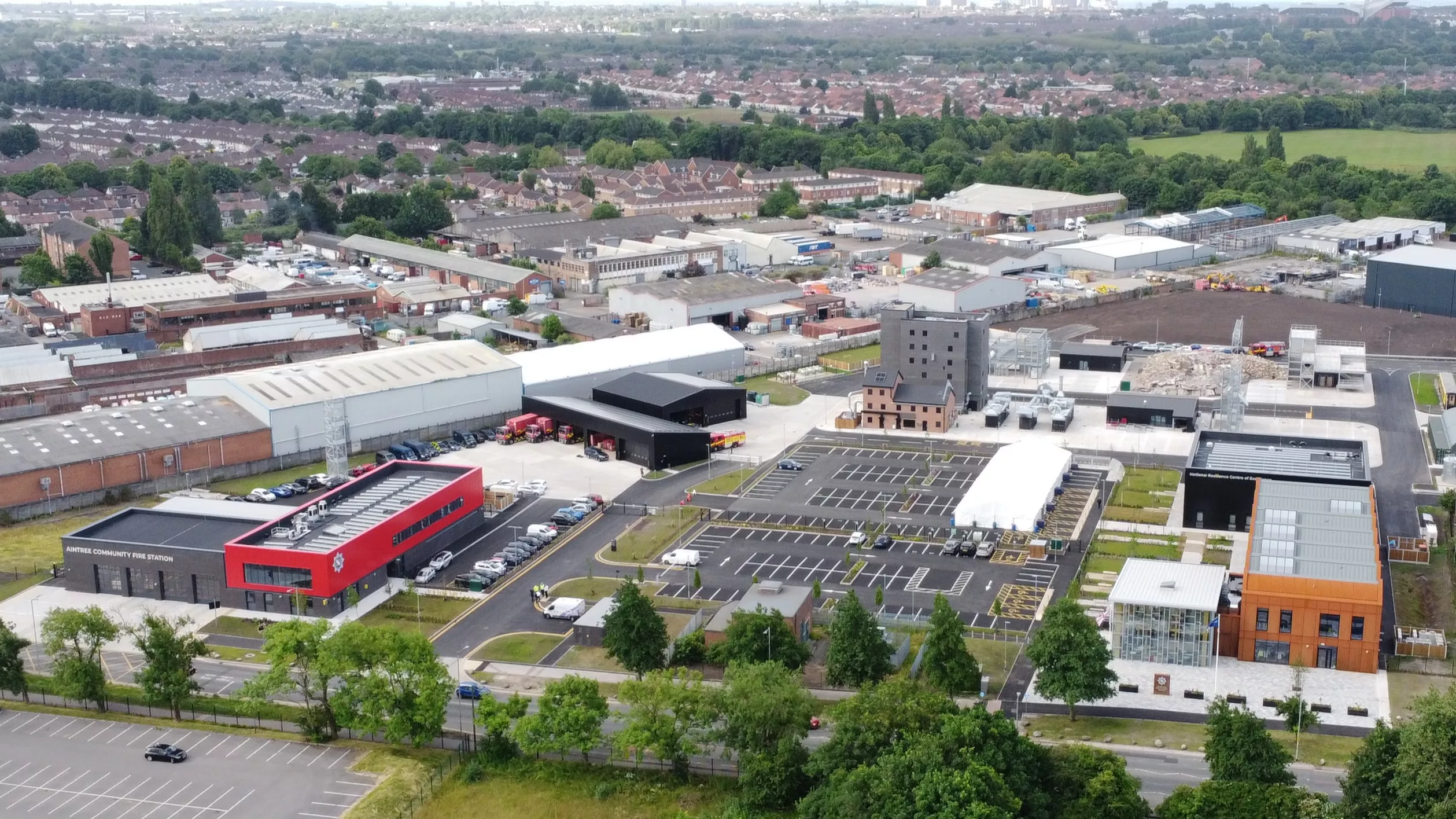
The development
MFRA’s £40 million development brings together three critical services onto a single 12-acre site.
The first service is the distinctive red-clad Aintree Community Fire Station, a 4-bay, multi-pump operational base responding to local emergencies. The decision to build it rationalised and updated two much older fire stations, one elsewhere in Aintree, the other in Croxteth.
The second is the Training and Development Academy (TDA), a state-of-the-art, purpose-built facility for immersive, scenario-based training used by commercial and publicly funded organisations both from the UK and overseas. As well as classrooms, it comprises mock-ups of physical structures to simulate an impressive range of possible emergency situations. It also has a suite of virtual training facilities that can be used for multi-agency incident simulations.
The third service is the Corten-fronted National Resilience Centre of Excellence, which accommodates the National Resilience Assurance Team (NRAT), the UK International Search and Rescue team (ISAR), and secondary fire control. This is the UK’s emergency response hub, a strategic investment of national importance jointly funded by the Home Office.
The brief for the campus was extraordinary because many of the mock-up structures needed to be used as live fire scenarios without compromising safety including a pile of rubble for search and rescue drills. The publicly funded project also set ambitious targets for environmental sustainability and social value.
Long-term partnership and standardised design
MFRA’s capital team enjoy a decade-long successful relationship with architect Ryder and main contractor Wates, having delivered five major fire station projects together. This continuity has had many strategic benefits, allowing all parties to learn and refine their ways of working for continuous improvement.
From the very first, MFRA understood the power of establishing a recognisable architectural identity – red cladding, corporate colours, and signage. The result is a property estate with a consistent brand that helps to embed MFRA into the local community.
That’s not all. The conscious effort to learn from past projects has also gradually made each new one more efficient. In effect, what went before informed the design, procurement and delivery of what came after, reducing costs and risk, and improving outcomes.
Early supply chain engagement and user-centric design
With such an unusual brief, MFRA understood how important it was to have early engagement with specialist suppliers. This effectively took the guesswork out of the project, enabling Wates to secure key materials and pricing ahead of market fluctuations and ensure that the design was buildable.
MFRA also engaged with stakeholders, from front-line operational teams and staff representatives to the wider community and partner organisations.
The combined strategy improved outcomes both from the point of view of the facility’s technical fitness for purpose and ensuring that it met users’ needs from day one.
Intelligent risk allocation and creative problem-solving
Delivering a training facility for life-critical, high-risk scenarios posed unique challenges. The buildings needed to simulate collapsed structures, live fire zones, and confined spaces without exposing anyone to actual danger.
MFRA played a pivotal role in navigating this complexity, shaping safe construction strategies for inherently hazardous environments. Their leadership was instrumental in supporting creative solutions, such as the use of pre-cast ramps and segmented tunnels to mimic underground rescue conditions.
Crucially, MFRA maintained a careful balance between innovation and regulatory compliance. Their strategic oversight of the way that risk was allocated empowered the project team to meet the brief without ever compromising on safety.
Integrated collaboration across teams
From concept to completion, MFRA nurtured a deeply collaborative culture. The design, procurement, and delivery teams worked in sync, solving problems jointly and sharing ownership of challenges and successes alike. Wates were given enough time and were trusted enough to engage niche suppliers and work out the best ways to deliver the project’s more unusual elements.
This collaborative ethos paid dividends. The project was delivered on schedule and with minimal disruption. More importantly, the completed project resolved the operational realities of a modern fire and rescue service without compromising the architect’s vision.
Embracing modern methods of construction
MFRA championed the use of modern methods of construction (MMC), enabling innovative techniques like off-site pre-casting of staircases, structural panels, and light shafts. Tunnel simulations were made possible by integrating precast drainage rings, while material choices were carefully tailored to withstand repeated exposure to heat and flame.
Adopting MMC allowed the team improved site safety, reduce material waste, and stay within budget.
Integrating digital technologies
MFRA’s core mission – saving lives and protecting firefighters – was central to the facility’s digital strategy. In particular, they understood the power of digital tech not just to reduce people’s exposure to danger but also to minimise the facility’s environmental impact.
Digital training tools were embedded into the design from day one. The facility now features fully immersive advanced technologies designed to test high-pressure decision-making under lifelike conditions.
Financial discipline
Using the Crown Commercial Service framework, MFRA were committed to prompt payment. Financial discipline of this kind helps to avoid common delivery pitfalls that arise from financial stress, including corner-cutting and disputes. Fair, prompt payment sets the conditions for contractors and suppliers instead to focus on quality and innovation.
In the event, every invoice was paid on time, ensuring robust cash flow throughout the supply chain and reinforcing trust between all delivery partners.
Continuous quality management
One of the chief messages of the CIOB’s Client Guide [MT1] is clients’ leadership role in promoting and sustaining a focus on quality. MFRA’s approach shows how this can work in practice. They maintained rigorous oversight of contractor performance from start to finish, supported by the strategic appointment of high-performing suppliers such as Sertus, who provided advanced smoke ventilation systems. Even once milestones were met, the team remained focused on marginal gains, constantly looking for ways to refine outcomes and enhance value.
The result is a facility that performs exactly as intended – both operationally and technically.
A commitment to inclusion and skills development
MFRA’s investment wasn’t limited to bricks and mortar. A deep commitment to inclusion and community uplift shaped the workforce behind the build. Over 500 local jobs were created within a 30-mile radius, with 37 full-time roles, nearly 1,000 apprentice weeks, and hundreds of training and volunteering hours delivered throughout the project. In total, £18 million was reinvested into the local supply chain.
The project team was notably diverse, with women in leadership positions, young people gaining first-time experience, and individuals from disadvantaged backgrounds given meaningful roles.
Sustainability
MFRA is committed to environmental sustainability, a tough proposition in the light of their day-to-day needs. Even so, they aimed to push for net zero, with a fabric-first design and energy being provided by air-source heat pumps and roof-mounted photovoltaic panels. Other environmental enhancements included installing 23 EV charging points and planting over 150 trees to boost biodiversity.
Lessons for construction clients
MFRA’s delivery model offers a blueprint for others, demonstrating what happens when the dominant project culture is focused on beneficial outcomes and supported by early engagement, prompt payment, and fair risk allocation. Of course, none of that can happen without clear leadership and a genuine commitment to long-term strategic partnership.
For public clients aiming to deliver infrastructure that offers lasting community benefit, MFRA’s approach provides a compelling and replicable example. They are a more than worthy winner of the CIOB’s 2025 Client Award.
Contact our Press Office
We welcome requests for information, comments and interviews from journalists across the globe, so please feel free to contact us: